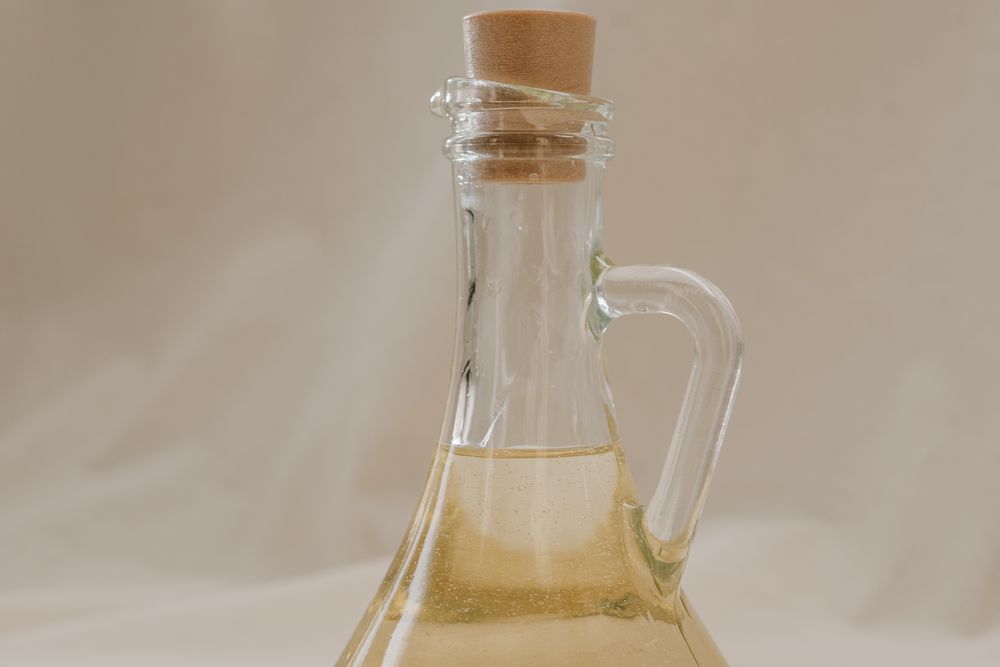
“I don’t want chemicals in the house, I’ve got vinegar.”
She had. Two litres of it, own-brand, standing next to a box of bicarbonate of soda and a lemon that had gone to leather on the windowsill. This was a first-floor flat in Nunhead, on a quote visit I didn’t win, and the woman who said it was right to want fewer chemicals in her home. She was wrong about four of the six jobs she was using the vinegar for.
I run an eco round. Most of what I clean with fits in three tubs and none of it carries a hazard pictogram, so it costs me something to say this. The eco staple people trust most is the one that fails most often, and the reason nobody catches it is that failure and success smell identical.
What Is In the Bottle Under Your Sink?
Distilled white vinegar sold for cleaning is about five per cent acetic acid. The other ninety-five per cent is water. The bottles marked “cleaning vinegar” go to six per cent, occasionally eight, and cost about the same, which tells you what the margin is on shipping water around the country.
The pH sits somewhere near 2.4 – between lemon juice and cola. It’s an acid, and a weak one in the chemical sense, meaning it doesn’t fully let go of its hydrogen in solution. That weakness is the whole story of this article. It’s strong enough to dissolve one specific family of household deposits and too feeble to touch most of the others.
Use the clear stuff. Malt vinegar is brown because of the caramel in it and it will tint grout, silicone and white plastic over a few months. I’ve seen a bathroom in Leytonstone where the sealant had gone the colour of weak tea and the tenant thought it was mould.
Why the Smell Convinces You It Worked
Your nose reports a sharp acid smell as an event. Something is happening. Then, inside ninety seconds, olfactory fatigue sets in, the sharpness drops away, and the room reads as neutral. Strong signal, then absence. That sequence feels exactly like work being done and finished.
Smell is not a result. It is the one feedback loop in domestic cleaning that runs entirely independent of whether anything came off the surface.
Which Jobs Does Vinegar Do Properly?
Limescale, and almost nothing else worth the name.
London water runs somewhere around 280 to 300 mg/l as calcium carbonate across most of the inner boroughs, which is hard by any definition anyone uses. Acetic acid converts calcium carbonate into calcium acetate, which is soluble and rinses away. That reaction is real, it’s quick, and it’s the reason vinegar survived as a cleaning product for four hundred years.
Kettles: half water, half vinegar, bring to the boil, leave twenty minutes, then rinse three times. The third rinse is the one everybody skips before ringing to say their tea tastes strange.
Tap aerators: unscrew the nozzle, drop it in an eggcup overnight, poke the mesh with a pin. A minute’s work that restores more flow than most people expect.
Shower screens: fifty-fifty in a trigger bottle, five minutes, squeegee, weekly. Scale and soap film build as a single layer and the acid takes the scale component with it, which loosens the rest.
Glass gets a qualified yes. Supermarket glass sprays leave a polymer film that builds up into that smeary bloom, and vinegar cuts it. Once it’s cut, warm water with a drop of washing-up liquid and a squeegee beats vinegar every time.
The Showerhead in Crouch End
Top-floor flat, tenant convinced the water pressure was dying, landlord with a plumber’s quote for a pump in his inbox. I bagged the head in neat vinegar with an elastic band on a Tuesday evening and came back the next morning with a pin. Forty minutes clearing jets. Pressure back to what it had been in 2019.
That’s a job worth doing, and it’s a job I didn’t charge for, because charging £90 for a sandwich bag would be theft.
Where Does It Do Nothing At All?
Grease. Start there, because it’s the failure that costs people the most time.
Fats and cooking oils are non-polar. Breaking them up needs a surfactant to surround them or an alkali to convert them, and an acid does neither. Spraying vinegar onto a roasting tin is watering it. The same goes for the oven door, the hob splashback, and above all the extractor filters, which want near-boiling water and soda crystals or a proper degreaser, or a hot dishwasher cycle on their own.
Mould in bathroom silicone is the second failure, and I’ve contributed to this one. For years I told customers to spray vinegar on black sealant. The colony isn’t on the surface, it’s growing inside the silicone body where it fed on the plasticisers. Nothing you spray reaches it. The vinegar does about as much as looking at it does.
Then disinfection. Vinegar is not a registered disinfectant, it doesn’t pass EN 1276, and if somebody in the house has had norovirus you want a product with a kill claim printed on the label and a contact time to observe. This is not the moment for the kitchen cupboard.
The Bicarb Volcano
Acid plus carbonate gives you carbon dioxide, water and sodium acetate. The fizz everyone films for the internet is the two ingredients destroying each other, and what sits in the plughole afterwards is faintly salty water.
Used separately they both have jobs. Bicarb is a mild abrasive and a deodoriser, vinegar handles scale. Poured together they’re a primary school science demonstration with a drain underneath it.
What Will It Ruin If You Keep Using It?
Anything made of calcium carbonate, which is a longer list than people realise. Marble, limestone and travertine worktops. Terrazzo. The cement-based grout in every tiled bathroom in the country. Victorian encaustic hall tiles, which turn up in half the terraces south of the river and are cement-bodied, not ceramic.
Etching isn’t a stain. The acid removes surface material and leaves a dull patch that no cleaning product on earth brings back, because there’s nothing sitting on top of it to remove. It needs a stone mason and a polishing pad.
Add waxed and oiled wood, where repeated acid strips the finish in exactly the traffic lines you’d expect. Add aluminium. Add the rubber door seals on washing machines and dishwashers – most manufacturers warn against acid descalers in writing, and a new seal on a Bosch is not a £5 problem. Add anti-glare screen coatings, which come off in patches and never go back on.
One Job I Paid For
Chiswick, 2023. Honed Carrara island, one of my cleaners, a fifty-fifty spray bottle she’d used in twenty other kitchens without incident. Three hundred millimetres of haze along the sink edge by the time I saw it on the Thursday.
The re-polish was £280 and I paid it inside a week, which I’d do again and would rather not have to. Nobody on my team carries an acid onto a stone job now, and the spray bottles are labelled in marker pen because two of my cleaners are Romanian and “citric” and “neutral” look similar at arm’s length on a dark worktop.
Is Vinegar the Eco Choice, or Just the Cheap One?
Here’s where I part company with most of the eco cleaning trade.
A five per cent solution is ninety-five per cent water, packed in a plastic bottle and driven from a warehouse to a shop to your kitchen. On the jobs where it fails, people don’t stop – they reapply, they leave it longer, they scrub, they run the hot tap for four minutes to rinse. Low-harm and ineffective adds up to more water, more heat, more product and more of your Saturday than a small dose of the right thing.
Citric acid is the better acid for nearly every job listed above. It ships as a dry powder, a kilogram tub runs about £8 and makes an absurd volume of solution, it’s stronger on scale than five per cent acetic, and it doesn’t make the flat smell like a chip shop for an hour. Soda crystals, around £2 a kilo, handle the grease that vinegar can’t touch. Those two plus a concentrated pH-neutral detergent replace the eleven bottles under most sinks.
A home that smells of nothing has either been cleaned or been aired, and you can’t tell which from the doorway. Smell is not a result.
What I Carry in the Van Instead
A kilo of citric acid, two kilos of soda crystals, a five-litre concentrate dosed at 1:100 into refillable bottles, white nylon pads, and forty microfibre cloths that go home in a laundry bag. One litre of white vinegar stays in the door pocket for descaling jobs where I want the acid wet and clinging on a vertical surface rather than running off, because acetic acid holds on a shower screen better than a citric solution does.
The two litres in Nunhead are still under her sink. I moved them behind the soda crystals and told her to keep them for the kettle.