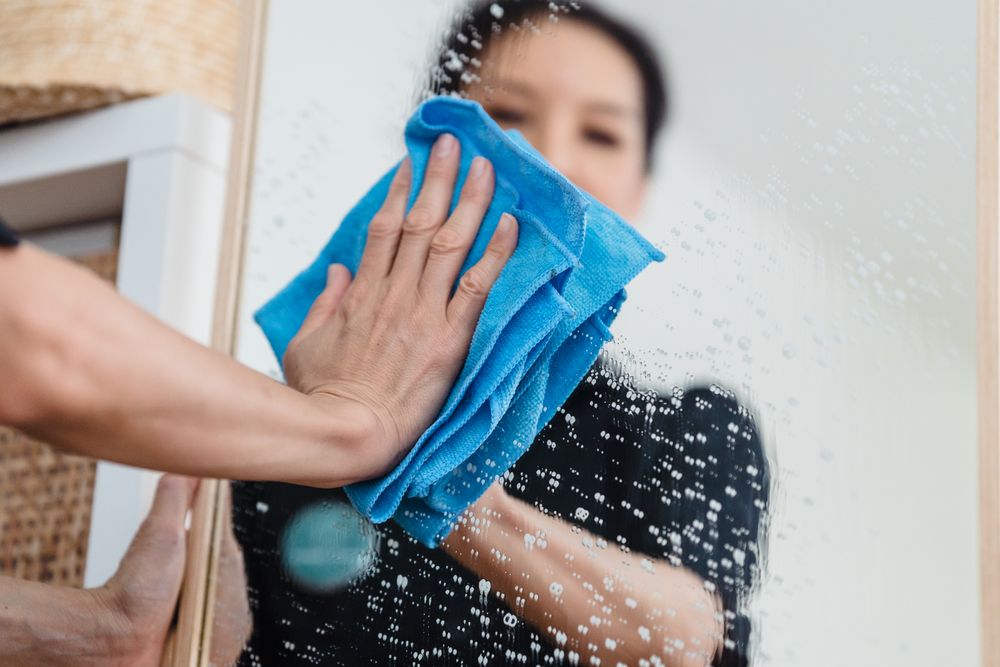
No. It’s a plastic textile that sheds plastic, and calling it eco because it lets you use less chemical is a sleight of hand the cleaning trade has been performing on itself for twenty years.
I have about four hundred of them. They go through a commercial machine three times a week and they are the single most useful thing I own. I’m not going to pretend I’ve found something better, because I haven’t, and anyone selling you a bamboo alternative that performs the same job is selling you a cloth that doesn’t.
So this is a piece about a compromise rather than a solution, which I appreciate is less satisfying than the version where the eco cleaner turns out to be blameless.
What Is a Microfibre Cloth Made Of?
Polyester and polyamide, which is to say polyester and nylon. Both are plastics, both come out of oil, and the good ones are usually split at around eighty per cent to twenty per cent.
The splitting is the clever bit and it’s the reason these things work. The fibres are manufactured as a bundle and then chemically or mechanically split into much finer strands, which creates an enormous amount of surface area and a lot of sharp edges at a microscopic level. That’s how a damp cloth with no product on it lifts grease and bacteria off a worktop — it’s mechanical, a huge number of tiny edges scraping and a capillary effect pulling the residue into the fibre.
It also means every wash drags a proportion of those fine strands loose. They go down the drain, through a treatment works that was never designed to catch anything that size, and out. A chunk of what’s caught in sewage sludge then goes onto farmland as fertiliser, which is the part of this that people don’t expect.
Why Bamboo and Cotton Don’t Do the Same Job
I’ve tried. Bamboo viscose, organic cotton terry, cellulose sponge cloths, the lot.
They absorb water well enough. They don’t have the split-fibre structure, so they don’t grip fine particles, and the practical result is that you need a chemical to do what the microfibre was doing mechanically. You end up spraying a product on a surface you used to clean with water.
That’s the trade, stated plainly: a natural cloth plus a detergent, or a plastic cloth and plain water. I don’t think there’s an honest way to present the first one as obviously greener.
How Much Plastic Does One Cloth Actually Lose?
Enough to matter and less than the headlines suggest, which is an unsatisfying answer I’d rather give than a confident wrong one.
Research on synthetic textiles has put shedding from a domestic wash load in the range of hundreds of thousands to millions of fibres, and microfibre cleaning cloths sit at the higher end of that because the fibres are so fine to begin with. What I can tell you from my own laundry is that a new cloth sheds hardest in its first few washes and settles down after that, and a cloth that’s past its useful life starts shedding badly again as the structure breaks down.
That shape matters more than the headline number. It means the worst thing you can do is buy cheap cloths and replace them often, which is exactly what most households and a fair few cleaning companies do.
A forty-pack for twelve pounds from a discount shop feels frugal. Those are thin, loosely woven, they lose their grip after fifteen washes, and every one of those washes is at the shedding-heavy end of the curve.
The Twelve-Pound Forty-Pack
I bought a case of them in 2019 to save money on a period when I had three flats a day going. They were noticeably worse at glass by the third week and they were going grey and limp by the second month.
I threw the lot out, which was its own small disgrace, and went back to buying proper ones at about two pounds fifty a cloth. Those last me eighteen months to two years of heavy commercial washing. Over that period the expensive cloth is cheaper per job and it sheds across a fraction of the washes.
Does a Filter Bag or a Washing Machine Filter Do Anything?
Yes, and this is where I’ll defend the thing I’ve spent the article criticising.
A capture bag — the common ones are the Guppyfriend and similar — holds the load inside a fine mesh and traps a large share of what comes off. Published testing puts the reduction in released fibres somewhere around seventy to eighty per cent, and you collect a small grey wad of lint from the seam after every few washes and bin it. Bin, not sink.
External filters that plumb into the machine’s waste hose catch more again but cost more and want a plumber unless you’re confident. France has required filters on new domestic machines since 2025, and the UK hasn’t followed, which is a policy failure rather than a technical one.
None of this is a fix. It’s interception, and the fibres still end up as landfill rather than in the Thames, which I’d take.
Wash Cold, Wash Full, Skip the Softener
Heat and agitation drive shedding, so thirty degrees rather than sixty wherever the job allows it, and a shorter cycle. Full loads shed less per item than half-empty ones because there’s less room for the textiles to thrash about.
No fabric softener, ever, on cleaning cloths. It coats the split fibres and destroys the grip that makes them work, and it does nothing useful to a cloth. Half the complaints I hear about microfibre not performing come down to somebody’s softener dispenser.
Tumble drying is the other one. High heat degrades the fibre and the lint filter is full of your cloth. Air dry them.
Is a Disposable Wipe Worse, or Are We All Fooling Ourselves?
Worse. Clearly, unambiguously worse, and it isn’t close.
A wet wipe is a nonwoven sheet that’s usually part plastic, used for four minutes, then thrown away wet with a biocide on it. Even the ones marked flushable cause the majority of sewer blockages in this country and Thames Water pulls fatbergs out of London sewers made substantially of them. Water UK’s “Fine to Flush” scheme existed and has been discontinued, which tells you how that experiment went.
Set against a single microfibre cloth that does eight hundred cleans and then goes in the bin, there’s no arithmetic that favours the wipe.
The same goes for the disposable mop pads and the scented sprays that go with them. A mop system where the head is binned after each floor is a business model rather than a cleaning method.
The Client Who Wanted Wipes Only
A flat in Ruislip, a client with a genuine anxiety about cross-contamination after an illness in the family, who asked me to use antibacterial wipes throughout and bring nothing reusable.
I did it her way for two visits because it was her home and her fear was real. Then I brought colour-coded cloths — red for bathroom, blue for general, yellow for kitchen, washed separately at sixty — and showed her the system. She’s been on cloths for three years. Colour coding is what professional hygiene actually looks like, and a wipe that’s been dragged across a worktop and a bin lid is the thing she was frightened of.
So What Should Be Under Your Sink?
Six to eight good cloths and nothing that comes in a forty-pack.
Buy them from a janitorial supplier rather than a supermarket. Look for a weight around 300 to 350 grams per square metre, an 80/20 blend, and a stitched edge rather than a cut one. Expect two pounds fifty to four pounds a cloth. Colour code them, wash them cold in a capture bag with a small amount of plain detergent, air dry, and keep using them until they stop gripping rather than until they stop looking new. Grey is fine. Grey is a cloth that’s been working.
Here’s the position I’d defend at any trade counter. The eco question in cleaning has almost nothing to do with cloths and almost everything to do with how many single-use plastic bottles come into the house and how far they travelled with water in them. A household running three concentrates and a set of refillables has made a bigger difference than one agonising over textile choice, by a wide margin.
And I’ll say the thing my own marketing would prefer I didn’t. Eco-friendly, as a phrase on a cleaning company’s website, means nothing. It has no definition, no certifying body behind it and nobody checks. Mine says it too. Ask instead what’s in the van, what the dosing is, how the cloths are laundered and where the waste water goes — four questions, and most firms can’t answer the fourth.
The oldest cloth in my kit is a blue one from a case I bought in Park Royal in 2021, and it’s gone almost white at one corner where it’s been folded the same way for four years.