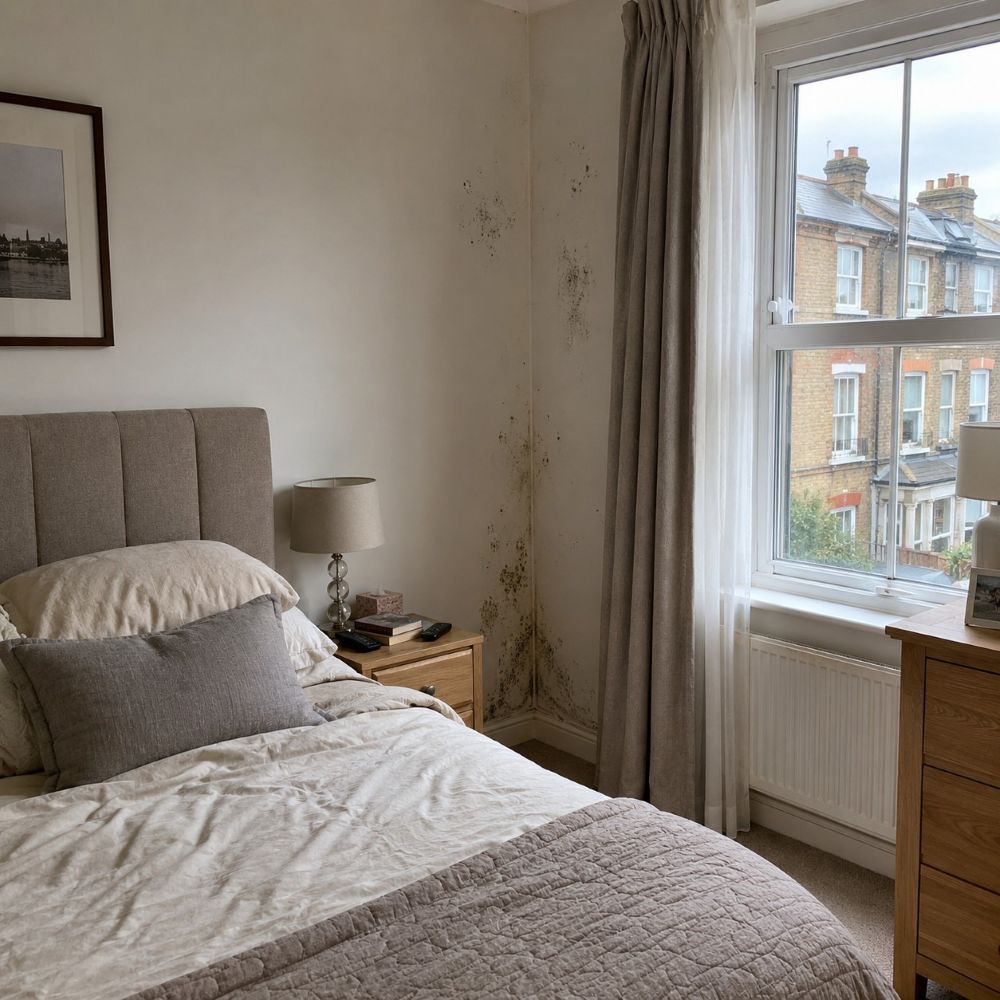
The smell comes back before the stain does. A fortnight after we’ve been in, somebody opens the wardrobe on a wet Tuesday morning and catches that damp-flannel note behind the winter coats, and by the weekend there’s grey freckling along the skirting again, in the same corner, in the same shape. The wall was scrubbed back to sound paint. Nobody has spilled anything. Nothing in the room has changed.
That last sentence is the whole answer. Nothing in the room has changed.
What did the deep clean actually remove from that wall?
Mould on a bedroom wall is a colony sitting on a food source, which is usually the paint film, the dust on the paint film, or the wallpaper paste behind it. When we clean it, we remove the visible growth and a good portion of the spores sitting loose on the surface. What we cannot remove is the condition that grew it – a surface that spends part of every night below dew point with air in the room carrying more moisture than that surface can tolerate.
So the wall goes back to being a clean, cold, damp wall. Spores land on it within hours, because spores are in every room in London and always have been, drifting in off the street, off your coat, off the pot plant on the windowsill. Two weeks is roughly how long it takes a fresh colony on a re-wetted surface to become visible to a person who is looking for it. If you weren’t looking for it, you’d notice at four weeks and assume it took a month.
Why bleach makes a wall look repaired for a fortnight
Household bleach kills what it touches and then decolourises what’s left. That second part is the problem, because a bleached wall reads as clean long after the hyphae under the paint have survived. On porous plaster, bleach is mostly water plus a whitening agent, and you have just added water to a wall with a moisture problem.
I’ll take an unpopular line here: the supermarket mould sprays are largely cosmetic on plaster, and the people who love them most are landlords doing a mid-tenancy inspection. They work beautifully on tile grout and silicone. On a painted external wall in a bedroom in Kilburn, they’re a fortnight’s worth of theatre. Ask me how I know.
Where is the water coming from if there’s no leak?
You. Four people in a two-bedroom flat put somewhere in the region of ten to twelve litres of water into the air every day, and a fair chunk of that is breathing and sweating overnight in a closed bedroom. Two adults asleep for eight hours will release roughly a pint of water each into a room with the door shut and the window on the latch at best.
That vapour is invisible and mobile until it meets something cold. Then it stops being vapour. The wall behind the wardrobe in a 1930s semi in Ealing gets no air movement, no radiator heat and no daylight, and it sits three or four degrees below the rest of the room. Air hits it, drops below dew point, and deposits water on the paint in a film too thin to see and too persistent to dry.
Dry your clothes indoors and you double the problem in one move. A single load of wet washing on an airer releases about two litres over a day and a half. In a flat in Deptford where the only place to dry is the bedroom because the hallway is a corridor and the kitchen has the boiler in it, that airer is a humidifier you paid for.
The cold-spot map of a typical London bedroom
The pattern is so consistent I can usually predict it on the phone before I see the room. Behind wardrobes and bed heads on external walls. The reveal beside the window, particularly on the hinge side. The top corner of the room where two external walls meet, which is a thermal bridge and always the coldest point in the box. Behind pictures on solid brick. Skirting level on the north elevation.
If your mould is in those places, you have condensation. If your mould is in a spreading tidemark from floor level upward, or feathering out from a single point on a ceiling, you have something else and no cleaner should be touching it until a builder has been.
Why does it come back in exactly the same corner every time?
Because the physics is unchanged, and because the surface is now more hospitable than it was before the first outbreak. Mould etches paint. It roughens the film, opens up micro-porosity, and leaves behind organic residue even after a thorough clean. The second colony establishes faster than the first on the same square metre. The third faster again.
There’s also a behavioural loop I see in almost every recurring case, and it’s the one nobody enjoys hearing about. The wardrobe goes back against the wall the same day, because where else is it going. The curtain gets rehung so it sits over the radiator, so the warm air goes up the glass instead of into the room. The window stays shut because the room is cold and the road outside is busy – I’ve had this argument in a first-floor flat on Stoke Newington Church Street where the traffic noise made the trickle vents unusable in practice, whatever they achieve on paper.
The bit about lifestyle that nobody wants written down
Landlords blame tenant lifestyle, tenants call that a dodge, and there is a whole cottage industry of damp surveyors selling injected DPCs into problems that are pure condensation. My position: the lifestyle explanation is usually factually correct and largely beside the point. Yes, the drying rack and the closed door and the twelve litres are the immediate cause. Also, a properly insulated wall with a working extract fan absorbs all of that behaviour without growing anything, which is why the identical family in the identical flat two floors up with the newer windows has no mould at all.
The moisture is yours. The tolerance is the building’s. Arguing about the first while ignoring the second is how a wall gets cleaned four times in a year.
Is there any point booking another clean at all?
Sometimes, honestly, no – and I say that in the knowledge that it costs me the job.
If you’re calling me because it came back for the third time in the same corner, a fourth clean is money spent on making the wall look right for a fortnight. I’d rather you spent that fee on a decent extract fan with a humidistat, or on getting the loft insulation topped up over that bedroom, or on a dehumidifier that gets left switched on. Come back to me afterwards, once the wall is dry, and one clean will hold for years.
There are cases where I’ll happily do it. Pre-tenancy and pre-photography work, where the wall needs to look right for an inspection and everyone understands what they’re buying. Cleans where the fix is already booked and the plasterer needs a sound surface. Cases where the outbreak followed a one-off event – a boiler flue that was blocked for a fortnight, a window left open in a storm in Wandsworth, a fish tank without a lid – and the cause has been removed. Those stay clean, because they were never condensation problems in the first place.
The jobs I turn down
Anything where the black growth is sitting on a wall that’s actively wet to the touch, or where there’s a musty smell with no visible growth at all, which usually means it’s behind something. Anything over about a square metre in a bedroom occupied by a baby, someone with asthma, or someone on immunosuppressants – that goes to a specialist remediation firm with containment and negative air, not to a house cleaning crew with a spray bottle. Ask me how I know. I took one of those jobs in my second year in a ground-floor flat off Lordship Lane, cleaned it beautifully, and the tenant’s cough came back within a month because the source was a failed gutter joint dumping water into the cavity every time it rained.
What actually keeps it off the wall after the clean?
Heat the room, move the air, and pull the furniture forward. That’s the entire strategy and it costs almost nothing.
Fifteen degrees continuously beats twenty-one for two hours and nothing for twenty-two – a bedroom that swings from cold to warm and back condenses on every downswing. Leave a five-centimetre gap behind the wardrobe. Open the window wide for ten minutes when you get up rather than leaving it on the latch all day, because a short hard purge dumps the overnight moisture without stripping the heat out of the plaster.
The extract fan in the bathroom matters more than anything happening in the bedroom, because that’s where the biggest single moisture load enters the flat. Most of the ones I meet in London rentals are either painted over, disconnected at the isolator, or venting into a loft void. Check yours is pulling by holding a square of loo roll to the grille while the shower runs. If it doesn’t hold, it’s decoration.
One thing to buy, if you buy anything
A cheap hygrometer, the sort that costs about eight pounds. Put it on the bedside table and watch it for a week. Above 65% relative humidity for sustained periods is your answer, and it turns an argument with a letting agent into a data set. I’ve had two tenants in Bermondsey get remedial work approved on the strength of a fortnight’s readings after eighteen months of being told to open a window.
Ask me how I know which of those two things a managing agent responds to.
The wardrobe corner in that Kilburn flat is still clean. It’s been fourteen months, the fan runs on a humidistat now, and the wardrobe sits four inches off the wall on a bit of timber batten the tenant cut himself.