Three of us walked the same flat in Bermondsey last October, within about a week of each other. Two bedrooms, one bathroom, a galley kitchen, a small balcony, no pets, two people working from home.
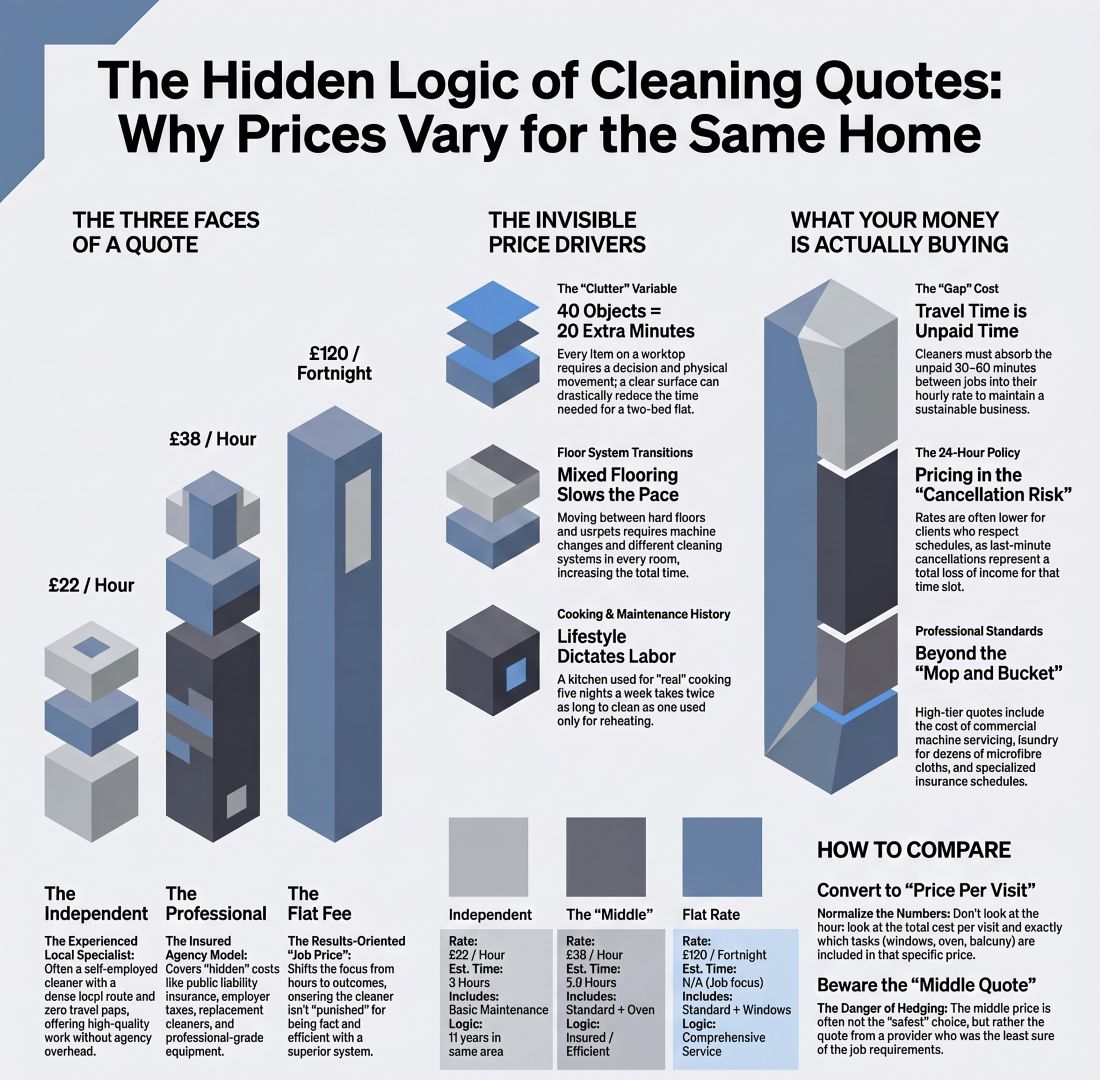
The quotes were £22 an hour for three hours, £38 an hour for two and a half, and a flat £120 a fortnight. Same flat, same brief, three numbers that don’t look like they describe the same job.
I was the middle one. I didn’t get it.
What Am I Actually Looking At When I Walk Round Your Flat?
The floors, first, before I’ve said hello properly.
Hard floor throughout is a different job from carpet throughout, and a flat with both is the slowest of the three because it means two systems and a machine change in every room. Then the bathroom — a glass screen with London scale on it, a shower tray with a raised lip, a fitted bath panel that doesn’t come off. Then the kitchen: hob type, splashback, whether the extractor filters look like they’ve ever been out, and how much stuff is standing on the worktop.
Clutter is the biggest single variable and nobody quotes it out loud. Forty objects on a kitchen worktop means lifting forty objects, cleaning under them and putting them back, and that’s not a cleaning task, it’s forty small decisions about where things live. A clear worktop and a clear windowsill can take twenty minutes off a two-bed. I can see that in the first thirty seconds and I’m pricing it before I’ve taken my coat off.
Then the things that don’t show up in a photograph. Whether the flat is on the third floor with no lift, because I’m carrying a machine. Whether there’s parking or whether it’s a controlled zone and I’m paying for a bay. Whether there’s a dog. Whether anybody will be home, which changes a two-hour job into a two-hour job with conversation in it.
The Questions I Ask That Sound Nosy
How often do you cook? Not small talk. Someone cooking properly five nights a week has a kitchen that takes twice as long as someone who reheats.
Who else has cleaned here, and when? A flat that’s had someone in monthly for two years is a maintenance job. A flat that’s had nothing for eighteen months has a first visit that is a different job entirely, and any cleaner quoting a regular rate on that first visit will either rush it or resent it.
And: is there anything you don’t want touched? The answer to that one tells me whether I’m walking into a household with rules, which is fine, and which costs time.
Where Does the £22 Come From, and Is It Real?
It’s real, and it’s usually one of three situations.
A self-employed cleaner with a full round in one postcode area, no travel gaps, no advertising spend, working cash or bank transfer and running her own book. At £22 an hour with six hours a day booked solid and no dead time between jobs, that’s a living, and she’s probably better at the actual work than most agency staff because she’s been doing it for eleven years.
Or somebody new, pricing to fill a diary, who will raise it within a year or leave the trade. I’d say half the people who start cleaning in London at under £20 an hour aren’t doing it two years later.
Or it’s an agency rate where the cleaner sees £13 of it, has four flats that day, and is timed. That’s the one to be careful of, because the low number isn’t buying you a cheaper version of the same service — it’s buying you someone who cannot afford to be slow in your bathroom.
The £22 is often the right answer. I say that as somebody who charges more.
What the Hourly Rate Doesn’t Tell You
Two cleaners at £22 and £38 might both be doing four hours of work. One is doing it in four hours and one is doing it in two and a half because she has a system and a better machine.
The number to ask for is the price for the job, not the price for the hour. What does a fortnightly clean of this flat cost, all in, and what’s included. Once it’s a job price, the hourly rate is our problem rather than yours, and a fast cleaner stops being punished for being fast.
What Am I Pricing In That You Can’t See?
The gap.
Nobody in this trade gets paid for the forty minutes between the job in Bermondsey and the job in Rotherhithe. Two jobs a day with a bad gap between them is an eight-hour working day billed as five, and the rate has to absorb that or the business doesn’t work. This is the single biggest reason a cleaner in your area is cheaper than one from three miles away, and it has nothing to do with quality.
Then: public liability and treatment risk cover. Products and cloths, replaced constantly. A commercial machine and its servicing. Laundry, which for me is three loads a week of cloths and mop heads and the electricity and detergent that goes with them. Fuel, or a travelcard. The van, its insurance, its tax, its MOT and the parking I pay for in about a third of the boroughs I work in.
Holiday and sick pay, which self-employed cleaners fund out of the rate or don’t have. Two weeks off in August is two weeks unpaid unless the rate carried it.
And the hours nobody counts: quoting visits like the one in Bermondsey, which take an hour with travel and are unpaid whether or not I win the work; messages in the evening; rescheduling; invoicing; chasing the invoice.
The Thing That Pushed My Rate Up Most
Cancellations.
A client who cancels on the morning takes that slot out of my week and I can’t sell it at nine o’clock. I hold a 24-hour policy now and I enforce it, which loses me the occasional customer, and the ones who stay pay a slightly lower rate than they would if I were absorbing everybody’s dentist appointments.
Is the £38 Cleaner Better, or Just Better at Selling?
Sometimes better. Sometimes insured and paying tax and pricing for a sustainable week. Sometimes an agency with an office, a supervisor and a replacement when somebody’s ill, which is a real product with a real cost.
And sometimes it’s a firm with a smart website and a call centre paying its people £13.50 an hour, which is under the London Living Wage, and keeping the difference. The website tells you nothing. I’ve been in flats behind very expensive-looking companies where the extractor filters hadn’t been out in two years.
Here’s what distinguishes them, and it isn’t the price. Ask what happens if you’re not happy. A serious operation has an answer ready — we come back within a week and redo it, no charge. Ask who comes. The correct answer is a name, the same name, every time, and if that person is ill, here’s who covers and how you’ll know. Ask what’s not included: interior windows, inside the oven, inside the fridge, ironing, bed changes, balcony. Those five items are where most disappointment lives, and every firm draws the line in a different place.
Ask for the insurance schedule as a PDF. A real one arrives inside the hour.
Why I’d Sometimes Send You to the Cheaper One
A regular fortnightly maintenance clean of a tidy two-bed in Zone 3 does not need an agency, and doesn’t need me. It needs a good independent cleaner at the going rate in your postcode, paid by standing order, left alone to get on with it and kept for five years.
Where the money is worth spending is the irregular stuff: the first deep clean, the end of tenancy, the flat you’re not living in, the property you need an invoice trail for. That’s the work I’d rather have anyway, and it’s the work where the difference between a good firm and a cheap one shows up in a document rather than an opinion.
How Should You Compare the Three Numbers You’ve Got?
Convert all three to a price per visit and write them down next to what’s included. That’s it. That single step resolves most of the confusion, because you’ll find the £22 quote is three hours and doesn’t include the oven, the £38 is two and a half and does, and the £120 fortnightly has interior windows in it that neither of the others mentioned.
Then look at the shape of the offer rather than the size of it. Somebody who quoted without visiting, or without asking about floors, pets and how often you cook, has guessed. A guess comes in low and gets corrected upward on visit three, or it comes in low and stays low and the corners come off the job instead.
Be suspicious of the middle one for the wrong reasons. People choose the middle quote because it feels safe, and the middle quote is frequently just the one that was least sure of itself. I’ve been the middle quote. It’s not a position of strength, it’s a position of hedging, and in Bermondsey I hedged because the flat had a balcony I didn’t want to price and I split the difference rather than ask a fourth question.
She went with the £22. Eleven years in the same postcode, standing order, every other Tuesday. I saw her van outside the block in February and it’s the same van.